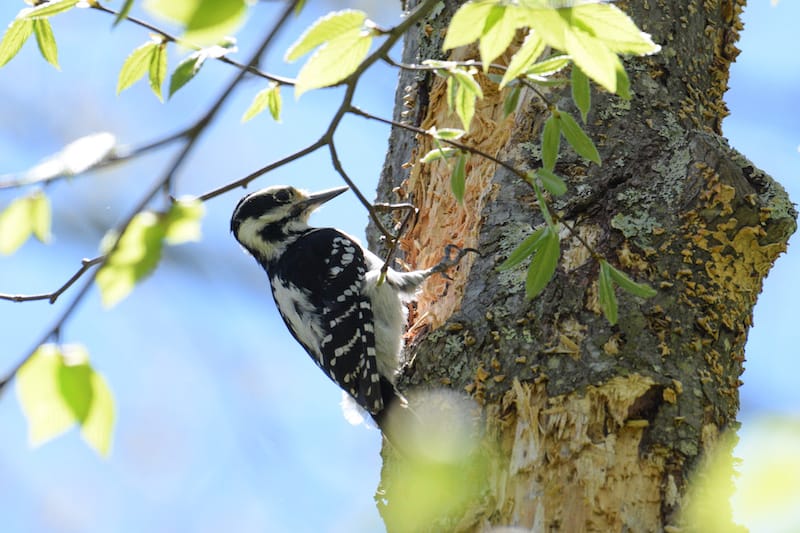
If you ever hear repetitive drumming in the woods, there’s a good chance a woodpecker is nearby. These birds are recognized around the world for their behavior of hammering into trees with their specialized bills. They’re found all across America in a wide variety of woodlands and forests. In this article, we’re going to review the 9 species of woodpeckers in Minnesota and the times of the year to find them.
Minnesota is located in the north-central United States and is bordered by Lake Superior and Michigan to the east, and North and South Dakota the west. It’s the 12th largest state by total area and offers plenty of mixed forests in addition to other geographic areas. The diverse range of habits enables many species of woodpeckers to call Minnesota home at all times of the year.
9 species of woodpeckers in Minnesota
The 9 species of woodpeckers found in Minnesota are the American Three-toed Woodpecker, Downy Woodpecker, Hairy Woodpecker, Red-bellied Woodpecker, Red-headed Woodpecker, Black-backed Woodpecker, Yellow-bellied Sapsucker, Northern Flicker, and Pileated Woodpecker.
1. Downy Woodpecker

Length: 5.5-6.7 in
Weight: 0.7-1.0 oz
Wingspan: 9.8-11.8 in
Downy Woodpeckers are commonly found year-round in Minnesota. They’re a small species of woodpeckers that are frequently found in woodlands, parks, and gardens.
Compared to other woodpecker species, Downy Woodpeckers are about the most likely to visit feeders, so setting one up in your yard is a great way to attract them. They enjoy suet blocks and sunflower seeds and have also been spotted drinking out of hummingbird feeders.
Downy Woodpeckers have the same characteristics as other, larger woodpeckers — but on a much smaller scale. They feature blocky heads, familiar black and white plumage, and share the same straight-backed posture when perched on the sides of trees. However, their bills are shorter than most other species.
2. Hairy Woodpecker